Archive for March, 2009


This 'F.M. Joyner' Caladium is a great spring planted bulb for a garden which gets large amounts of shade in the summer.
This ‘F.M. Joyner’ Caladium is a great spring planted bulb for a garden which gets large amounts of shade in the summer. 

Spring or Fall Bulbs: Who Says You Have to Choose?

“I had planted fall bulbs in a small garden area and now I am wondering if I am able to plant Spring bulbs in the same garden without hurting the daffodils, tulips, hyacinths, and crocus?”

~Paula

One of my readers, Paula, asked the above question in a recent email. And this is how I answered: ABSOLUTELY! Making use of the same garden space to plant both summer-/fall-blooming and spring-blooming bulbs is a great use of different plants for year round color! Planting dahlias and gladiolus next to daffodils and tulips is not only a good idea, it is a necessity for an “all bulb garden”. Here are three quick tips when planning a garden of this kind:

  1. Be sure you know where your previously planted bulbs are located, or be prepared to accidentally dig some up :) . The best course of action is to plant your fall planted bulbs FIRST, and then plant your spring planted bulbs while your spring bloomers are actively growing. This way you will know exactly where the other bulbs are planted. If this does not work for you, simply mark the plants with small popsicle sticks while they are growing. This will tell you approximately where not to dig when you go to plant your bulbs for the next season.
  2. If you do accidentally unearth a bulb which you did not intend to, simply re-plant it at the appropriate depth. Chances are, it will still come up at the correct time if the roots were not badly damaged.
  3. Consider the sunlight conditions in the designated area carefully when selecting your bulbs. Just because tulips (which like full sun) do well in your flowerbed, does not necessarily mean that canna lilies (which also require full sun) will do well. Keep in mind that a place in your yard which receives full sun in the early spring time, may not receive this much sun once all of the trees have leafed out. In some cases, you may need to select full sun bulbs for planting in the fall but ones which can withstand partial shade in the summer months (which are planted in the spring).

So go for it! Be daring and plant both types of bulbs in the same garden! I promise: they’ll get along just fine :) And congratulations to Paula for having her question featured in this post! She now has an extra $5.00 to spend on her spring planted bulbs from Holland Bulb Farms!

Spring is here!

Spring is here!

Until next time,

grcbb_signature1


Got a gardening question and need some help? Why not ask Bridget?! Send your question to bridget@bulbblog.com. If she features your question in a blog post, you’ll receive a coupon for $5.00 off your next order with Holland Bulb Farms!

Wise Dirt

“If we had no winter, the spring would not be so pleasant; if we did not sometimes taste of adversity, prosperity would not be so welcome.”

~Anne Bradstreet

Oh no! My bulbs are already sprouting! What do I do?

“My daffodils are starting to come up…the problem is that it is starting to snow a bit. Should I cover up the green that has started to sprout? I don’t want them to die!”

~Tammy from Cincinnati, Ohio


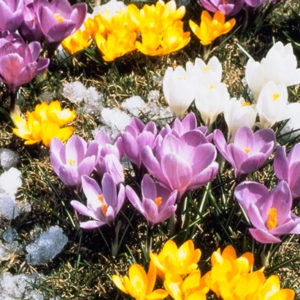
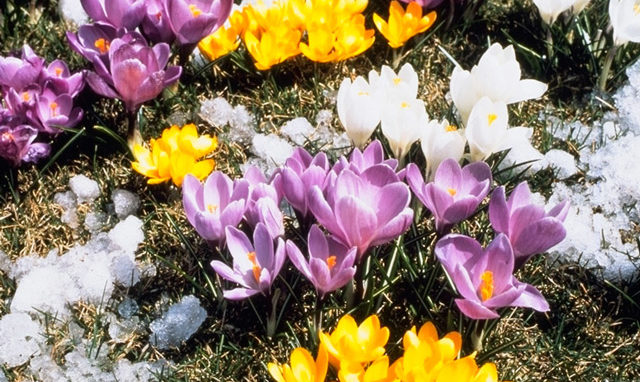
Crocus are a very early spring blooming bulb and often come up while the snow is still on the ground!

Does this sound familiar? At the middle to end of winter, we all hope for those warmer days with bright sunshine. But what about when those days come in the middle of January or February before the spring is really here? Oftentimes, these “touches of spring” can cause premature sprouting of bulbs. The growth starts showing itself above the ground, giving us hope of warmer days to come, only to be smothered with snowflakes a week later. So what is the best plan of action in a situation like this?

Well, my first piece of advice is simple: do not worry too much. If your bulbs are starting to come up early, they are simply reacting to the weather around them, which is out of your control. Think about it this way: if these bulbs where growing in the wild (as they originally did), they would experience this same thing from time to time and would still flourish without the intervention of any human. A little bit of foliage growth during freezing temperatures is not a big deal for these bulbs and should not affect their flowering in the months to come. If this happens in the wintertime, chances are that more cold weather is on its way. In this environment, the foliage will yellow and die back, returning the bulb to its “dormancy” period. This is completely normal and should just be allowed to happen.

Now if the weather continues to stay unseasonably warm, there is a slight chance that the bulbs may begin to produce flower buds. If this happens, your intervention may be necessary in order to protect these buds. Simply find some dry leaves, straw, or even sawdust to cover the sprouting plants and buds. Once the weather begins to warm and the threat of frost is gone, uncover the plants and allow them to continue to grow as normal. If the frost does happen to get to these flower buds, those flower buds will be damaged for the current season. However, this does not necessarily mean that the bulb will not produce additional flower buds at the proper time and then bloom as it normally should. Also, this one-time “frosting” will not have any adverse affect on the bulb’s performance in the years to come.

One more quick thing to keep in mind: sometimes bulbs sprout prematurely simply because the weather is unseasonably warm. However, sometimes there are factors we as gardeners create which can cause this premature sprouting. These factors are planting time and planting depth. Be sure that you wait until the weather is cool enough (consistently in the 40’s at night) in the fall to plant your spring blooming bulbs. Use the thermometer as your gauge and not just the calendar…as we all know, weather can be unpredictable and does not always turn cool at the same time every year. Planting your bulbs too early can cause them to then sprout too early. Also, keep in mind that most bulbs should be planted three times their height in depth. For example, if the bulb you are planting is approximately 2″ tall, then the top of this bulb should be covered with approximately 6″ of soil. Planting bulbs too shallow can cause premature growth as well.

Bulbs tend to take care of themselves...sit back and enjoy them!

Bulbs tend to take care of themselves...sit back and enjoy them!

Hopefully this article will calm some of your fears regarding your eager spring blooming bulbs! The most important thing to remember is that in most cases, nature can take care of itself. As long as your bulbs are planted correctly, your spring garden will be absolutely beautiful!

Until next time,

grcbb_signature1


Have a question for Bridget? Email her at bridget@bulbblog.comIf Bridget features your question in a blog post, you’ll receive a $5.00 coupon from one of our sponsors Holland Bulb Farms! Congratulations to Tammy for receiving her coupon!