Archive for February, 2009

What spring planted bulb are you most familiar with?

  • Begonias. (41.0%, 18 Votes)
  • Cannas. (20.0%, 9 Votes)
  • Gladioli. (18.0%, 8 Votes)
  • Dahlias. (14.0%, 6 Votes)
  • I don't know much about spring planted bulbs at all. (7.0%, 3 Votes)

Total Voters: 44

Loading ... Loading ...
This pink dahlia is a sure sign the summer is here!

This pink dahlia is a sure sign the summer is here!

HELP! I ran out of time to plant my fall bulbs! Now what?

“I know you’re not supposed to plant fall bulbs in the spring but we were hit with hard winter weather rather early this year and I am left with at least 100 tulip and daffodil bulbs that were unable to get planted. Would they survive to bloom next year if I were to plant them now?”

~Dianne from Idaho

Dianne asks a very good question…and one I’ve heard quite often! We all know what it’s like to have the greatest plans for our yard that never seem to quite materialize. Sometimes you even get so motivated that you actually purchase the bulbs and yet they still never make it in the ground! Whether it’s a forgetful mind, the unpredictability of Mother Nature, or just plain running out of time, it’s okay: we’ve ALL done it. And the best news? It may not be too late for your bulbs!

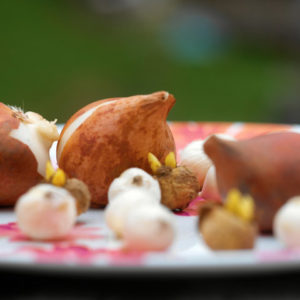
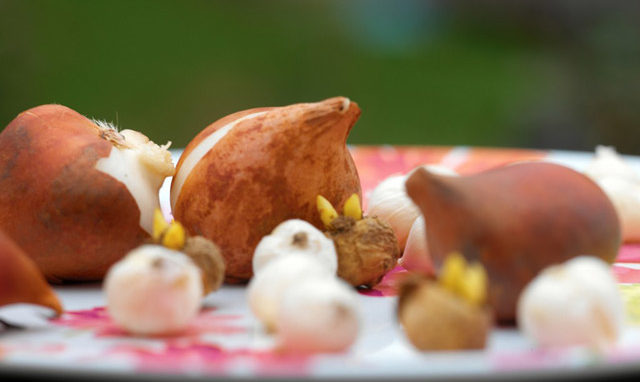
These bulbs were bought with good intentions...anything you can do with them now?

These bulbs were bought with good intentions...anything you can do with them now?

The most important factor to consider when deciding what to do with fall bulbs which were never planted in fall is the conditions in which they have been stored. Were they kept in a cool, dry place since you bought them? Were they left out in the garage? Were they left on the warm kitchen table? Test your bulbs for firmness by squeezing them. Also look for signs of rot or blight by checking the outside of the bulbs for dark or mushy spots. If the bulbs feel firm and have a rather healthy-looking outside, then you’ve got yourself some winners! Most likely, if the bulb was left outside or in a very cold garage and was allowed to freeze, it is no longer salvageable.

So now that you’ve determined that your bulbs are still healthy enough to survive, it’s time to get them “chilled.” As you may or may not know, most fall bulbs (tulips, daffodils, and hyacinth to be specific) need to be chilled in order to grow and bloom properly in the springtime. When planting them in northern climates which receive consistently cool weather in the winter (Zones 3-8), this happens naturally. However, since your bulbs were not planted before the winter and now the ground is frozen, the bulbs can no longer be planted in the ground this year. This leaves you with two options:

  1. Plant the bulbs in one large (or a few small) pots. Plant them at the correct depth but don’t worry too
    These 'Queen of Night' Tulips need to be chilled in order to grow and bloom correctly.

    These 'Queen of Night' Tulips need to be chilled in order to grow and bloom correctly.

    much about the spacing. As long as the bulbs aren’t on top of one another or smashed side-by-side, they’ll be fine. Place this pot in a cool but not freezing garage (upper 30’s and 40’s for temperature). If you do not have a garage or shed which meets this criteria, the pot can be left outside on a patio or deck as long as it is wrapped in something which will protect it from frost (such as burlap or bubble wrap). The bulbs will then receive their necessary “chilling” period but will not freeze. In approximately 10 to 12 weeks or so, you should start to see a little growth. Once this happens, move the pot to a nice sunny patio or lawn area (or remove the bubble warp). The bulbs will continue to grow and bloom just as they would in the ground. The bulbs can then be dug out of the pot and moved to a flowerbed either during their growing cycle or after the foliage has browned and dried. OR…

  2. Place the bulbs in a paper bag in the refrigerator. Be sure that the refrigerator is set at a temperature between 35°F and 50°F. Also, rid the refrigerator of any fruit (particularly apples) as these produce a plant hormone called “ethylene” when ripening which will cause flower bulbs to rot. After a period of 10-12 weeks, the bulbs may start to sprout. At this time, the ground outside should be thawed and the bulbs planted in the ground. They will then grow and bloom as normal!

One important thing to keep in mind when doing this is that the environment required by these bulbs is being artificially created. Therefore, be forgiving of your bulbs and do not expect them to be super all-star growers and bloomers the first year. It may take them a little while to readjust but after they have completed their first full growing season, you’ll never be able to tell the difference!

Because Dianne’s question was featured in the Bulb Blog, she received a $5.00 off coupon for her next Holland Bulb Farms order. Congratulations to her and thank you for the great question! Keep them coming and you may get a coupon, too!

Until next time,

grcbb_signature1

Got a gardening question for Bridget? Email her at bridget@bulbblog.com! If she features your question in a post, you’ll receive a coupon of your next order at www.hollandbulbfarms.com!

Did I Miss My Chance to Plant Bulbs?

Lilies are one of the only winter hardy spring planted bulbs and are also extremely gorgeous!

Lilies are one of the only winter hardy spring planted bulbs and are also extremely gorgeous!

I’ve gotten several questions regarding tulips and daffodils from novice gardeners, wondering if they’re “too late” to plant these bulbs. My answer to these good-intentioned diggers in the dirt is yes. Unfortunately, these fall-planted bulbs need to be planted at the proper time in order to bloom correctly in the spring. This is why some of you may be having a difficult time finding these types of bulbs (daffodils, tulips, hyacinth, crocus, iris, and allium to name a few).

But do not despair! You can still jump on the bulb bandwagon! Did you know that there are actually bulbs which are meant to be planted in the springtime

The 'Postman Joyner' Caladium has striking red centers to its leaves.

The 'Postman Joyner' Caladium has striking red centers to its leaves.

for a summer bloom? Many people have heard of dahlias, canna lilies, calla lilies, and gladiolus, but not as many have grown them. These bulbs add great spalshes of color to your gardens long into the growing season and most of them make GREAT CUTFLOWERS! What could be better than going out into your own garden on a summer day and picking yourself a bouquet of fresh flowers which you grew yourself!

Since these bulbs are much less familiar than tulips, daffodils, and hyacinth, I thought I’d give you a quick overview of the types available and how they are grown:

  • Caladiums - Caladiums are wonderfully textured plants, grown primarily for their foliage. The leaves of this particular plant range in color from white to pink to red to different hues of green. These bulbs are sold as tubers and are planted just below the ground surface in partial to full shade areas. They will begin growing the same year they are planted and will put on their amazing foliage display from summer until frost. Caladiums are hardy from Zones 9 to 11. Many gardeners in more northern zones still grow Caladiums; they are either treated as an annual or are dug up in fall and replanted in spring.
  • Calla LiliesCalla Lilies are one of the most popular flowers for fresh flower arrangements and are often seen at weddings. Their elegant shape and varying heights make them
    Calla Lilies make an elegant statement in the garden!

    Calla Lilies make an elegant statement in the garden!

    a nice addition to the garden. These bulbs are sold as tuberous rhizomes and are to be planted just below the soil surface in full to partial sun areas. They will begin to grow and bloom the first year in mid-summer. Calla Lilies are hardy from Zones 8-10 and Zone 7 with winter protection. Calla Lilies can be grown in northern zones as annuals or dug up in fall to overwinter in a cool, dry place.

  • Canna Lilies - Canna Lilies are grown for their great height, colorful flowers, and showy foliage. These lilies add a tropical feel to any landscape which make them nice for plantings near a patio and/or pool. These bulbs are sold as rhizomes and are planted just below the soil surface in areas receiving full sun. They will begin to grow and bloom the first year in mid-summer.  Canna Lilies are hardy in Zones 8-11, need protection in Zone 7, and are treated as annuals or dug up in fall for Zones 4-6.
  • DahliasThere are literally thousands of Dahlias available in a wide array of shapes, sizes, and colors. This very popular plant produces beautiful, brightly-colored flowers and are sold as tubers. They are planted approx. 3-4″ below the ground’s surface (depending on the size of the bulb) in partial to full sun areas. They will begin to grow and bloom the first year in late summer and stay in bloom until frost.  Dahlias are hardy from Zones 8-10, need protection in Zone 7, and are treated as annuals or dug up in fall in Zones 4-6.

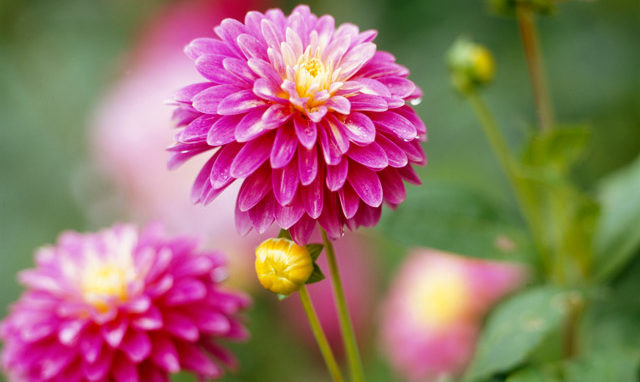
    These pink dahlias are some of my favorites!

    These pink dahlias are some of my favorites!

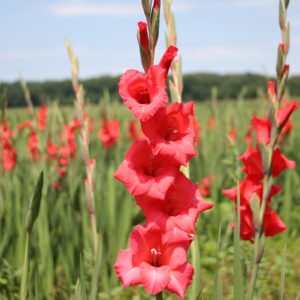
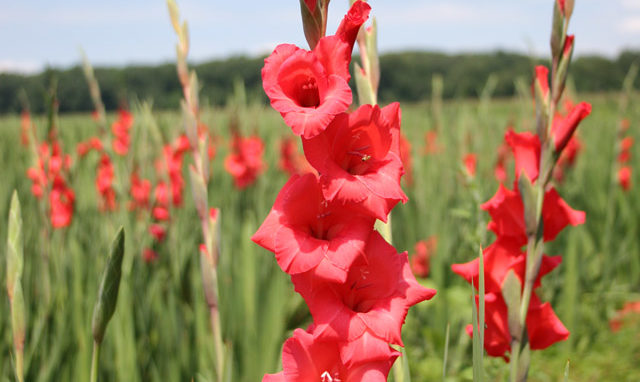
  • GladiolusGladiolus are very common in formal floral arrangements and are easy-to-grow, summer-blooming plants which are sold as corms. They are planted approx. 3-4″ below the ground’s surface (depending on the size of the bulb) in full sun areas. They will begin to grow and bloom the first year in late summer. Gladiolus are hardy in Zones 8-10 and Zone 7 with winter protection. Gladiolus can also be grown in northern zones up to Zone 4 if they are treated as annuals or dug for overwintering in the fall.

    Gladiolus are commonly used in cut flower arrangements for their great color and form.

    Gladiolus are commonly used in cut flower arrangements for their great color and form.

  • Asiatic/Oriental LiliesAsiatic and Oriental Lilies are wonderful additions to any cut flower garden and are extremely easy to grow. Sold as a bulb, these lily bulbs should be planted approx. 6-8″ below the ground’s surface (depending on the size of the bulb) in full sun area. They will begin to grow and bloom the first year in mid summer. Asiatic and Oriental Lilies are both winter hardy and therefore can be grown in Zones 3-9 with no fear of winter weather.

So don’t feel like it’s too late to try your green, or not so green, thumb at planting some bulbs! Come summertime, you’ll be very glad you did!

Until next time,

grcbb_signature1

Have a question for Bridget about spring planted bulbs? Send your question to bridget@bulbblog.com! If Bridget features your question on the Bulb Blog, you’ll recieve a $5.00 coupon for your next order at www.hollandbulbfarms.com!


Our Most Recent Poll

Can’t stop thinking about spring? You’re not alone! Vote in our poll and compare your favorite parts of spring with others. Check back to see results!

What is your favorite thing about Springtime?

  • Gardening, of course! (45.0%, 32 Votes)
  • The smell of a fresh rainshower. (31.0%, 22 Votes)
  • The sound of birds chirping. (23.0%, 16 Votes)
  • Washing the dog's muddy feet. (1.0%, 1 Votes)

Total Voters: 71

Loading ... Loading ...

How to Find the Perfect Flower for the Perfect Lady

33061 Tulipa Pallada

Surprise her this year with a unique bouquet!

“Think staying power when choosing flowers,” advises Sally Ferguson, the director of the Netherlands Flower Bulb Information Center.  “For long-lasting flowers, choose tight buds just beginning to open.  Fully-open flowers are short-hitters,” says Ferguson whose website, bulb.com, offers these and other cut flower tips.

More flowers are sold on Valentine’s Day than any other U.S. holiday and, not surprisingly, men are the major buyers. 

 “Roses are the most commonly-given Valentine’s flowers, but tulips are closing in as a creative alternative,” says Ferguson.  “Last Valentine’s season, one major national floral retailer alone reported delivering three million roses and nearly one million tulips for the holiday,” she said. Ferguson says, with either of these favorites, the most important thing is to buy buds that are fresh and gift-worthy. Why not go out on a limb and try buying her some Calla Lilies this year? Score extra points if you buy the flower that adorned her wedding bouquet!  Here are some tips to picking the perfect flower:

Cut calla lilies, classic white

Classic white calla lilies cut in a vase.

Non-Traditionalist:  Picking Perfect Calla Lilies

  • Petals that spring back when touched
  • Straight stems (try either classically long for formal vases or stylishly short for low vases)
  • Monochromatic (all one color) generally preferred
  • Deliver promptly – need water quickly and don’t respond to sitting all day in a box, unless kept cool
  • Use cut flower food provided by florist 

  Uncoventional: Choosing Perfect Tulips

  • Look for tight buds with some color showing
  • Red, Pink, Apricot, and bi-colors dominate for Valentine’s Day
  • Monochromatic looks are stylish or pick several for a more fun, flirty touch
  • Skip flower food; tulips tend to like plain, cool water — top vase off daily
  • Consider potted tulips instead of cut for an unusual gift that will be a lasting treasure!  
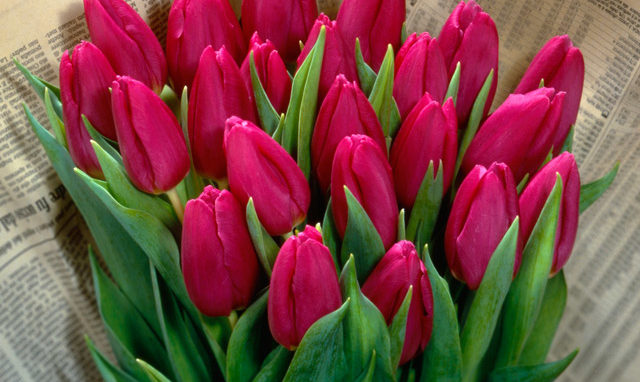
Surprise her with a new twist and buy a bouquet of tulips!

Tulips are a great alternative to the over-used rose bouquets!

 After all, you can’t really go wrong with flowers. Says Ferguson, “Candy is fattening, lingerie risky, but flowers are almost always sure to please.”  For longer vase life for all flowers, she adds: re-trim stem tips before arranging, remove leaves below the water line to keep water fresh, and place vases away from sun and heat.  For additional cut flower tips, visit bulb.com.

 Want to REALLY impress her next year? Why not try planting and growing your own spring or fall bulbs for cutflowers! What could be more personal than giving the love of your life flowers which you grew yourself?!


Want to Grow Bulbs but Confused About When to Plant?

We’ve all seen it: the neighbor’s yard full of brilliant tulips, daffodils, and hyacinth in the spring…or the gorgeous fenceline covered with vibrantly-colored dahlias and lilies in the late summer. Wouldn’t we all love to grow flowers like these? You can! The key is knowing when to plant what and then remembering to do it! So here’s a quick guide to help assist you in planning your garden:

17538 Plant Tulips in Fall

Hardy spring bulbs such as tulips are planted in fall because they need a period of cold in order to stimulate the biochemical process that makes them flower in spring. (Photo: NFBIC)

When to Plant Fall Bulbs?

First of all, bulb planting times are pretty much divided up into two seasons: spring and fall. When an experienced garden refers to “fall bulbs“, they are most likely referring to bulbs which are planted in the fall and therefore bloom in the spring. These bulbs are typically the most familiar and include the following: tulips, daffodils, hyacinth, allium, iris, crocus, fritillaria, and muscari. So what exactly does “fall” mean? Depending upon where you live, fall may start in late September for you or not until mid-November! A good rule of thumb to follow: wait until the nighttime temperatures are consistently between 40°F and 50°F. In most areas, October is a pretty good month to safely plant your fall bulbs. Just be sure to get the bulbs in the ground prior to a severe frost but not too early that they sprout pre-maturely.

77022 Dahlia 'Gerrie Hoek'

Dahlias are great summer bloomers! (Photo: NFBIC)

When to Plant Spring Bulbs?

Conversely, when referring to “spring bulbs“, a gardener is most likely referring to bulbs which are planted in the spring and therefore bloom in the fall. These  bulbs are not planted quite as often as the fall bulbs but are still fairly easy to grow and produce gorgeous blooms! They include the following: begonias, calla lilies, cannas, caladiums, elephant ears, gladiolus, lilies, freesia, cyclamen, and anemone. Again, the season “spring” may vary based upon your Hardiness Zone. Basically, once the ground has thawed, your spring bulbs can be planted. The weather should be consistently above freezing at this point with the chances of a frost slim to none. In most areas, April is a perfect month to do your spring bulb planting.

Hope this information helps clear up any confusion about when to plant the types of bulbs you desire to grow. Now that you know when to plant bulbs, get out there and plant them! Too many times we marvel at the flowers when they are blooming and commit to planting them ourselves, but by the time the correct season comes around to do it, we never do! Do you have a desire for a yard full of tulips? Take a picture of some and hang it on your fridge with a note saying, “Plant fall bulbs in October.” This way you won’t forget how much you love them when the time comes to plant! Are you envious of your neighbor’s Gladioli? Snap a quick shot and place the picture in the pocket of your spring coat to remind you to plant your own! Just wait and see: you, too, will have beautiful gardens!

Until next time,

grcbb_signature1


Have more questions about planting bulbs? Ask Bridget at bridget@bulbblog.com. If Bridget features your question in a future blog, you’ll receive a coupon good on  your next purchase at www.hollandbulbfarms.com!