Entries tagged with “Begonias”.
Did you find what you wanted?
Fri 12 Feb 2010
Brilliant Begonias!
The next type of spring-planted bulbs we’re going to focus on is the Tuberous Begonia. Known for their wonderful ability to grow in the shade, small habit and lush green foliage, these tubers make great addition to shady gardens and borders. In this article, we’ll review the advantages of using these beauties in your garden, as well as different planting techniques and tips for growing them.
Classification

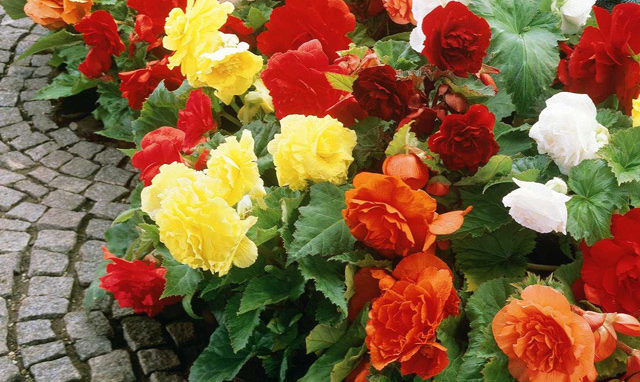
Begonias work wonderfully along walkways and as borders to other shaded gardens.
Tuberous Begonias can typically be grouped into three types: Begonia tuberhybridia, Begonia multiflora, and Begonia pendula. The Begonia tuberhybridia types are the most commonly grown and well-known and include the Double Begonias, Ruffled Begonias, Roseform Begonias, and Picotee Begonias. The Begonia multiflora variety include the Multiple Flowering varieties with smaller, numerous blooms. The Begonia pendula are the Hanging Basket-type of begonias which trail over the edges of planters and pots. Oftentimes, the novice gardener will confuse these tuberous begonias with wax begonias, which are grown more as an annual or indoor plants and not from a tuber (or bulb).
Tubers for all three types of these begonias are typically available for purchase in late winter/early spring. They look like small brown lumps with a depression on one side. When choosing the tubers, be sure to check for firmness and look for those with tiny sprouts on the upper, concave surfaces. This is a good sign that they are healthy and ready to begin growing!
Growing Begonias
As previously mentioned, Begonias should be planted during the spring season, anytime after the threat of frost is gone but before the weather gets too warm. For most of the United States, this time period falls between mid-March and mid-May. Maybe begonia growers located in cooler climates, choose to start their begonias early (middle to end of February) indoors to give them a head start on the growing season. Many bulb companies will over this “early delivery” as on option on this partcular type of spring-planted bulb. (For more detailed information on just how to go about starting these tubers indoors, be sure to check out last year’s blog article here: http://www.bulbblog.com/start-begonias-indoors/)

This Sunrise Scentiment Begonia is of the "ruffled" type and is not only pleasing to look at, but also provides a wonderful fragrance!
Begonias will begin blooming mid-summer and will continue until frost! Begonias thrive in partial to full shade and need to be protected from hot sun and drying winds. The key to successfully growing begonias is to make sure the soild is well-drained. Begonia tubers are extremely susceptible to rot and therefore do not like any excess moisture. However, be sure to not let the soil dry out between waterings during the summer months. Fertilize once per month during the growing season with a water soluble fertilizer (such as Miracle-Grow).Always water the soil around the plants rather than the plants themselves whenever possible to avoid the forming of fungus or mildew on the foliage. The tubers should be planted hollow side up and covered with only 1/2 to 1″ of soil. Planting them too deep will only encourage rotting. Water well after planting to “wake up” the tubers but then not again until you see growth, which usually takes 4-6 weeks.
For aesthetic reasons, pink off extra long stems as the plants grow. This will encourage blooming and keep your plants from looking “leggy”. When growing the hanging basket-type, make sure they have lots of branches to cascade from their plants by pinching out the primary growing tip when the plant is 2″ tall. Also, deadhead your begonias often by removing wild=ted leaves and flowers. This will retain the “clean” look of the plants and will also encourage repeat blooming throughout the season.
Tuber Storage
Once the plants have completed their growing and blooming cycle, the leaves and flower stems will begin to die back as they enter their dormant stage. Begonias are hardy in Zones 8, 9, and 10. In these areas, simply cut the stems back to within 1-4″ of the soil surface once they have completely died back. Leave the tuber in the ground for the remaining fall and winter. If located in zones north of Zone 8 (Zones 1-7), you will need to take special care of the tubers in order to protect them from the harsh winter weather. Southern parts of Zone 7 can usually get away with giving the tubers a good drink of water in the fall and placing a think layer of mulch over the area where the tubers are planted. To be really sure, however, the tubers will need to be removed from the soil and overwintered indoors. To do so, follow these simple steps:
- Since begonia tubers tend to be susceptible to rot, it is often a good idea to bring them indoors just before the first frost. If grown in movable planters, bring the planters indoors and gradually begin with-holding water. Once the leaves begin to die and wilt, remove the stems and leaves carefully from the tubers.
- If your tubers are planted outside in the garden, simply dig them up (plant and bulb together) and bring them indoors prior to the first frost. The foliage will begin dying back quickly and can then be removed.
- Gently brush off any excess dirt from the tubers and place them in a tray or pot with dry sand, peat moss, or vermiculite.
- Store them in a cool, well-ventilated, frost-free area such as a cellar or garage over winter. A temperature of 45-55°F is ideal.
- Replant in the spring once ground has thawed!
Those who grow Begonia tubers are some of the most passionate gardeners on earth…and it’s easy to see why! Looking absolutely gorgeous with their bright, large blooms and lush green foliage, it’s hard to believe these plants don’t need much sunlight! Whether you’re a “begonia growing veteran” or have never tried them before, be sure to make your selections early this year and get them growing as soon as possible!
Until next time,

Have a question about begonias or any other bulb gardening topic? Ask Bridget! Email her at bridget@bulbblog.com! If she features your question in a future post, you’ll receive a Holland Bulb Farms coupon for your next order at Holland Bulb Farms!
Fri 10 Apr 2009
Which End is Up?
One of the most popular questions asked by beginners to bulb gardening is, “How do I know which end of the bulb to plant up?” While the answer to this question can vary based on the type of bulb, generally speaking, the pointed end of the bulb should be planted up (such as with a tulip, daffodil, or hyacinth). Also, if a bulb is smaller than the size of a nickel, there really isn’t a top and bottom.
The good news is that bulbs are quite smart and they’ll figure out which direction to grow, regardless of how they are planted! If a bulb is planted upside down, it will simply take an extra day or two to reach the surface. If after deliberating over which end is the top and you still can’t tell, plant the bulb on its side. Once again, the bulb is smart enough to know which way to grow and will now only have to travel half the distance to the surface.
A few bulbs, especially some of those bulbs planted in spring, have a more definite answer to the question. For instance, begonia tubers have a concave and convex side. In this case, the “hollow” side of tuber should be planted down and the “rounded” side up. Other tuberous spring planted bulbs such as cannas and callas grow long and narrow. These should be planted horizontally 1″ or 2″ below the ground’s surface.

The smooth side of the Elephant Ear bulb is the top and should planted up.
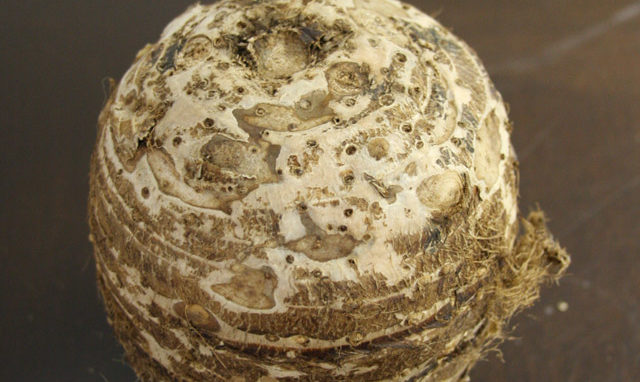
Perhaps one of the most confusing bulbs to know which direction to plant is the Elephant Ear. As those of you who have previously planted one know, an Elephant Ear bulb is very round and has no definite “points”. However, most of these bulbs will have a smooth side as well as a side that contains more bumps and maybe even a few root hairs from the previous growing season. The smooth side of the Elephant Ear is typically the top and should be planted up. Chances

The bumpy side of the Elephant Ear bulb is the bottom and should be planted down.
are, the bumpy side with some possible hairs is slightly flatter than the smooth top side. This is the bottom. Like all bulbs, an Elephant Ear will know which way to grow regardless of how it is planted. When in doubt, plant it on its side! See pictures below for more clarification.
Spring is definitely here and gardeners everywhere are rejoicing! So get out in the garden and get to work! It’ll make you feel good
Easter blessings,

Have a question about which way to plant your bulbs or any other gardening topic? Ask Bridget! Email her at bridget@bulbblog.com! If she features your question in a future post, you’ll receive a coupon for your next order with Holland Bulb Farms!
Fri 27 Feb 2009
What spring planted bulb are you most familiar with?
- Begonias. (41.0%, 18 Votes)
- Cannas. (20.0%, 9 Votes)
- Gladioli. (18.0%, 8 Votes)
- Dahlias. (14.0%, 6 Votes)
- I don't know much about spring planted bulbs at all. (7.0%, 3 Votes)
Total Voters: 44

Loading ...

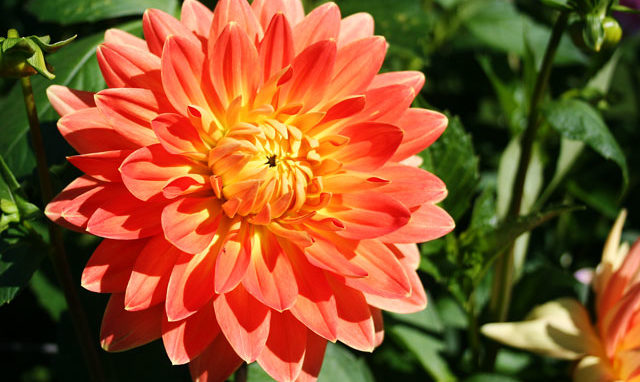
This pink dahlia is a sure sign the summer is here!
Thu 15 Jan 2009

Some of the growers' fields which provide many of the begonias Holland Bulb Farms sells.
Tired of Winter? Start Spring Early with Indoor Forcing!
So the cookies have all been eaten, the Christmas tree is at the curb, and the stockings are no longer hung. Yet even though the holidays are over, the winter “duldrums” are plentiful: you’re still zipping up your bulky coat before leaving the house, you barely make it home before the sun has set, and your shovel hasn’t seen much of a break. So what now?
It is easy at this time of year to feel somewhat hopeless about the outdoors and wish that you could hibernate like the bears do. So why not start your gardening early? Most summer-blooming bulbs are great for forcing indoors, even before the ground has thawed! Not only will starting your plants indoors boost your mood and add some color to the bleak winter, but it will also give your plants a head start for the summer season. Come springtime, you’ll have the most vigorous plants in the neighborhood!
Starting Begonias Indoors
Today, I figured I’d explain the steps to starting your begonias indoors for fuller, more vigorous growth. Begonias are a great bulb to experiment with if this is your first shot at forcing since they are one of the most successful to begin indoors. Begonias also tend to be quite popular, due to their brilliant colors and ability to grow in shady areas (not to mention the namesake of my four-legged gardening buddy
) . Simply perform the following steps and you’ll be well on your way to having gorgeous begonias!

White double begonias in the grower's greenhouse.
ITEMS YOU WILL NEED:
- Begonia tubers
- Well-drained soil
- Seed trays or small pots
- Paper or plastic wrap
- General plant fertilizer
- Water
WHAT TO DO:
- Fill the seed trays or small pots with soil.
- In late February or March, plant the tubers (hollow side up) just below the soil level. Soil should be somewhat moist.
- Cover with paper or plastic wrap and place on a window sill or other location with indirect maximum light. Temperature should not fall below 60°F.
- Water sparingly until growth begins (may take up to 5-6 weeks to see growth above ground although roots have started).
- Once shoots emerge from the soil, remove paper or plastic wrap and begin watering regularly. An application of a good liquid plant food will improve growth.
- Once substantial growth has formed and leaves have begun to appear, transplant plants to outside container or garden.
It’s that simple! When picking a location outdoors for your begonias, remember that they thrive in semi-shade so avoid areas which receive direct midday sun. Begonias also dislike dry conditions, so be sure to water generously, especially during periods of hot weather. As with most plants, an application of well-balanced plant food every two to three weeks will encourage healthy, vigorous growth. Just remove dead, wilted leaves and flowers and you’ll have begonia blooms all summer!

The new 'Sunrise' Scentiment Begonia!
One more quick note: People are always asking me about where to purchase the newly developed fragrant begonias. One of the only places I have found them is at www.hollandbulbfarms.com. These are referred to as Scentiment® Begonias and grow with a fresh, lemony scent!
Help yourself out this year by bringing spring into your home early! And say goodbye to the winter duldrums! Good luck!
Until next time,

Like this article? Want to learn more about indoor forcing other types of bulbs? Email Bridget at bridget@bulbblog.com!