Entries tagged with “Spring Planted Bulbs”.


Which End is Up?

One of the most popular questions asked by beginners to bulb gardening is, “How do I know which end of the bulb to plant up?”  While the answer to this question can vary based on the type of bulb, generally speaking, the pointed end of the bulb should be planted up (such as with a tulip, daffodil, or hyacinth). Also, if a bulb is smaller than the size of a nickel, there really isn’t a top and bottom.

The good news is that bulbs are quite smart and they’ll figure out which direction to grow, regardless of how they are planted! If a bulb is planted upside down, it will simply take an extra day or two to reach the surface. If after deliberating over which end is the top and you still can’t tell, plant the bulb on its side. Once again, the bulb is smart enough to know which way to grow and will now only have to travel half the distance to the surface.

A few bulbs, especially some of those bulbs planted in spring, have a more definite answer to the question. For instance, begonia tubers have a concave and convex side. In this case, the “hollow” side of tuber should be planted down and the “rounded” side up. Other tuberous spring planted bulbs such as cannas and callas grow long and narrow. These should be planted horizontally 1″ or 2″ below the ground’s surface.

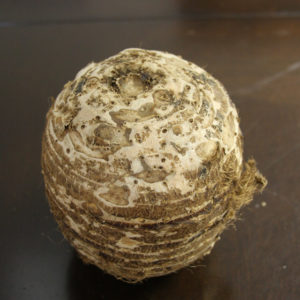
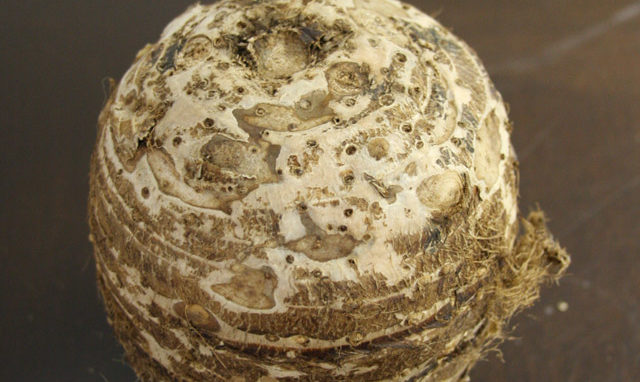
The smooth side of the Elephant Ear bulb is the top and should planted up.

The smooth side of the Elephant Ear bulb is the top and should planted up.

Perhaps one of the most confusing bulbs to know which direction to plant is the Elephant Ear. As those of you who have previously planted one know, an Elephant Ear bulb is very round and has no definite “points”. However, most of these bulbs will have a smooth side as well as a side that contains more bumps and maybe even a few root hairs from the previous growing season. The smooth side of the Elephant Ear is typically the top and should be planted up. Chances

The bumpy side of the Elephant Ear bulb is the bottom and should be planted down.

The bumpy side of the Elephant Ear bulb is the bottom and should be planted down.

are, the bumpy side with some possible hairs is slightly flatter than the smooth top side. This is the bottom. Like all bulbs, an Elephant Ear will know which way to grow regardless of how it is planted. When in doubt, plant it on its side! See pictures below for more clarification.

Spring is definitely here and gardeners everywhere are rejoicing! So get out in the garden and get to work! It’ll make you feel good ;)

Easter blessings,

grcbb_signature1


Have a question about which way to plant your bulbs or any other gardening topic? Ask Bridget! Email her at bridget@bulbblog.com! If she features your question in a future post, you’ll receive a coupon for your next order with Holland Bulb Farms!

What spring planted bulb are you most familiar with?

  • Begonias. (41.0%, 18 Votes)
  • Cannas. (20.0%, 9 Votes)
  • Gladioli. (18.0%, 8 Votes)
  • Dahlias. (14.0%, 6 Votes)
  • I don't know much about spring planted bulbs at all. (7.0%, 3 Votes)

Total Voters: 44

Loading ... Loading ...
This pink dahlia is a sure sign the summer is here!

This pink dahlia is a sure sign the summer is here!

Did I Miss My Chance to Plant Bulbs?

Lilies are one of the only winter hardy spring planted bulbs and are also extremely gorgeous!

Lilies are one of the only winter hardy spring planted bulbs and are also extremely gorgeous!

I’ve gotten several questions regarding tulips and daffodils from novice gardeners, wondering if they’re “too late” to plant these bulbs. My answer to these good-intentioned diggers in the dirt is yes. Unfortunately, these fall-planted bulbs need to be planted at the proper time in order to bloom correctly in the spring. This is why some of you may be having a difficult time finding these types of bulbs (daffodils, tulips, hyacinth, crocus, iris, and allium to name a few).

But do not despair! You can still jump on the bulb bandwagon! Did you know that there are actually bulbs which are meant to be planted in the springtime

The 'Postman Joyner' Caladium has striking red centers to its leaves.

The 'Postman Joyner' Caladium has striking red centers to its leaves.

for a summer bloom? Many people have heard of dahlias, canna lilies, calla lilies, and gladiolus, but not as many have grown them. These bulbs add great spalshes of color to your gardens long into the growing season and most of them make GREAT CUTFLOWERS! What could be better than going out into your own garden on a summer day and picking yourself a bouquet of fresh flowers which you grew yourself!

Since these bulbs are much less familiar than tulips, daffodils, and hyacinth, I thought I’d give you a quick overview of the types available and how they are grown:

  • Caladiums - Caladiums are wonderfully textured plants, grown primarily for their foliage. The leaves of this particular plant range in color from white to pink to red to different hues of green. These bulbs are sold as tubers and are planted just below the ground surface in partial to full shade areas. They will begin growing the same year they are planted and will put on their amazing foliage display from summer until frost. Caladiums are hardy from Zones 9 to 11. Many gardeners in more northern zones still grow Caladiums; they are either treated as an annual or are dug up in fall and replanted in spring.
  • Calla LiliesCalla Lilies are one of the most popular flowers for fresh flower arrangements and are often seen at weddings. Their elegant shape and varying heights make them
    Calla Lilies make an elegant statement in the garden!

    Calla Lilies make an elegant statement in the garden!

    a nice addition to the garden. These bulbs are sold as tuberous rhizomes and are to be planted just below the soil surface in full to partial sun areas. They will begin to grow and bloom the first year in mid-summer. Calla Lilies are hardy from Zones 8-10 and Zone 7 with winter protection. Calla Lilies can be grown in northern zones as annuals or dug up in fall to overwinter in a cool, dry place.

  • Canna Lilies - Canna Lilies are grown for their great height, colorful flowers, and showy foliage. These lilies add a tropical feel to any landscape which make them nice for plantings near a patio and/or pool. These bulbs are sold as rhizomes and are planted just below the soil surface in areas receiving full sun. They will begin to grow and bloom the first year in mid-summer.  Canna Lilies are hardy in Zones 8-11, need protection in Zone 7, and are treated as annuals or dug up in fall for Zones 4-6.
  • DahliasThere are literally thousands of Dahlias available in a wide array of shapes, sizes, and colors. This very popular plant produces beautiful, brightly-colored flowers and are sold as tubers. They are planted approx. 3-4″ below the ground’s surface (depending on the size of the bulb) in partial to full sun areas. They will begin to grow and bloom the first year in late summer and stay in bloom until frost.  Dahlias are hardy from Zones 8-10, need protection in Zone 7, and are treated as annuals or dug up in fall in Zones 4-6.

    These pink dahlias are some of my favorites!

    These pink dahlias are some of my favorites!

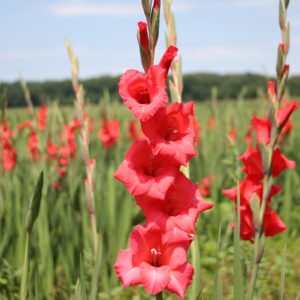
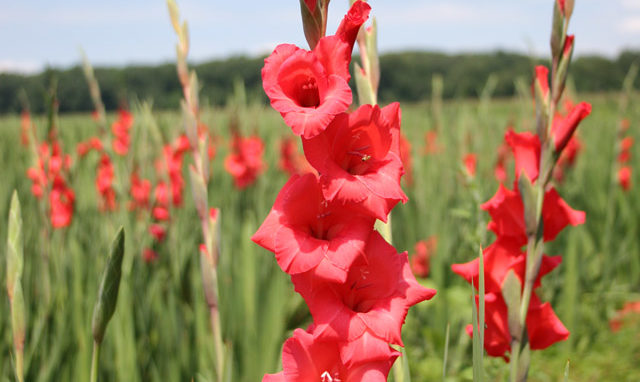
  • GladiolusGladiolus are very common in formal floral arrangements and are easy-to-grow, summer-blooming plants which are sold as corms. They are planted approx. 3-4″ below the ground’s surface (depending on the size of the bulb) in full sun areas. They will begin to grow and bloom the first year in late summer. Gladiolus are hardy in Zones 8-10 and Zone 7 with winter protection. Gladiolus can also be grown in northern zones up to Zone 4 if they are treated as annuals or dug for overwintering in the fall.

    Gladiolus are commonly used in cut flower arrangements for their great color and form.

    Gladiolus are commonly used in cut flower arrangements for their great color and form.

  • Asiatic/Oriental LiliesAsiatic and Oriental Lilies are wonderful additions to any cut flower garden and are extremely easy to grow. Sold as a bulb, these lily bulbs should be planted approx. 6-8″ below the ground’s surface (depending on the size of the bulb) in full sun area. They will begin to grow and bloom the first year in mid summer. Asiatic and Oriental Lilies are both winter hardy and therefore can be grown in Zones 3-9 with no fear of winter weather.

So don’t feel like it’s too late to try your green, or not so green, thumb at planting some bulbs! Come summertime, you’ll be very glad you did!

Until next time,

grcbb_signature1

Have a question for Bridget about spring planted bulbs? Send your question to bridget@bulbblog.com! If Bridget features your question on the Bulb Blog, you’ll recieve a $5.00 coupon for your next order at www.hollandbulbfarms.com!