Entries tagged with “bulbs”.
Did you find what you wanted?
Fri 8 Jan 2010

- Don’t be a grump just because it’s cold! Start your “summer dreaming” now!
Beat the Winter Duldrums: Start Planning your Summer Garden TODAY!
For those of us who live in “cold winter” areas, as Begonia and I do, right about now the snow is beginning to “lose its luster”. The holidays are over with nothing left to look forward to but another several months of wet boots, red noses, and frozen car doors. So why not bring the spring and summer INTO your home by starting your “summer dreaming” a little early this year?!
Did you realize that many online as well as catalog bulb and perennial companies have already started accepting pre-orders for spring planted items, such as cannas, callas, dahlias, and assorted perennials? You can be far ahead of the game just by beginning to plan now and making your selections before the spring rush begins.
So you may be wondering: how do I even begin to decide what I want to plant this year? Even though this may seem like a daunting task, planning your garden should be one of the most fun and enjoyable things you do! Make it easy on yourself this year by following these easy steps:
- Decide on a location. Pick a spot of your yard that you feel needs “extra attention”. Or perhaps for you it’s simply your favorite raised planter or decorative container. Have a specific project, such as a flowerbed around your mailbox or in that shaded part of your already existing garden? Perhaps this is the year you want to tackle it! Whatever you do, don’t “over-commit” yourself. Doing so will only leave you tired and frustrated. Have the courage to a pick a slightly smaller project and do it WELL rather than taking on more than you can handle and leaving yourself disappointed by the results.

Let your imagination bring the warm weather to you even on the coldest day!
- Start collecting ideas. Collect all of the information you can find: garden magazines, website and blog articles, plant catalogs, and web addresses to some of your favorite plant sources. When you see something you like, tear it out or print it off and begin a “summer dreaming” journal. Try not to get too hung up on plant height, color, light requirements, etc. at first. These will only limit your creativity.
- Look through your treasures. Once you feel you have collected a good amount of information, sit down with your journal and sort through what you have found. Can you find any common themes in the plants/ideas you’ve selected (formal garden settings, color patterns, exotic-looking plants?). Begin to think about these ideas in relation to the location you had pre-determined to “fix-up” this year. Will they work here? Does the area get enough sunlight or too much? Do the colors go together or do they clash?
- Begin building the dream. Now that the information you have collected has been somewhat organized, decide which direction you will take and separate the plants/ideas that will be included this season. Do NOT throw the rest of it away! Keep all of these ideas in a folder to re-visit at a later time and don’t EVER tell yourself “no” to an idea you truly love. Yes, it may be true that you don’t have the money to have an 8 foot tall marble fountain in the middle of your backyard surrounded by 5′ cannas. But that doesn’t mean you can’t someday do something very similar, just on a smaller scale. Again, it may be true that you just don’t have enough sunlight in your backyard to grow the climbing wisteria vine you’ve always dreamed of but that doesn’t mean that there aren’t other climbing perennials which would work wonderfully in a more shaded landscape and provide just the same effect.
- Go shopping! Join newsletters and email lists to your favorite websites and suppliers and begin watching for coupons. Start finding specific sources for your purchases and don’t wait too long to place your order. Once the weather starts to warm up, there will be many gardeners thinking about making these purchases and you won’t want to get left out in the cold
From now on, whenever the winter rain, sleet, or snow starts to get you down, head to your favorite garden website or magazine and continue your “summer dreaming”. It won’t be long before it’s here and you want to be ready for it, don’t you???
Until next time,

Have a question about your “summer dreaming” or any other bulb gardening topic? Ask Bridget! Email her at bridget@bulbblog.com! If she features your question in a future post, you’ll receive a Holland Bulb Farms coupon for your next order at Holland Bulb Farms!
Mon 3 Aug 2009
Iris: The Apple of my Gardening Eye
An old-time favorite but still a very frequently used perennial, the Iris is truly timeless. Whether it be a the romantic, frilly Beardeds or the more modern, chic Dutch Iris, both add elements to the garden which are unmatched among other perennials. August is often referred to as “Bearded Iris Month” simply because bearded iris like to be planted in late August or early in September for best results. Today I thought I’d just give a general overview of both for those readers who may be slightly unfamiliar with the difference or maybe just wanted their memory refreshed.
Typically sold as “rhizomes”, Bearded Iris (or sometimes called German Iris) are the elegant queens of the late spring

This Red at Night Bearded Iris is one of the most popular!
garden. The rhizomes are planted just below the soils surface, with little to almost no soil cover. The roots grow out of the bottom of this rhizome, creating a solid foundation for which the plant to grow. These Bearded Iris typically produce blooms made up of standards (the petals which stand upright) and falls (the petals which point downwards). The falls are covered with a soft “fuzz”, creating the beard which gives the iris its name! These rhizomes are best planted during the fall season but be sure to give them plenty of time to become established prior to any frost. They are great naturalizers (meaning they multiply quickly) and are reliably perennial. If you’re interested in more than a one time bloom, check out some of the Reblooming Bearded Iris!
Dutch Iris, although similar to Bearded Iris in bloom shape, have many of

This Orental Beauty Dutch Iris boast of bi-colored blooms of yellow and lavendar.
their own characteristics which make them highly sought after. Their extremely narrow, long leaves make elegant additions to cut flower arrangements and the blooms tend to last an extremely long time making them a florists’ favorite! Dutch Iris come in a variety of blues, yellows, purples, and white. If you’re looking for a more unique, later spring-blooming boarded plant, try some of the dwarf varieties like the Cantab or the Danford Dwarf Dutch Iris!
So do yourself a favor this year and plan for fresh cutflowers out of your own garden next spring! Plant Iris SOON! And if you need some help choosing, try checking out some great Bearded Iris Collections!
Until next time,

Have a question about iris or any other bulb gardening topic? Ask Bridget! Email her at bridget@bulbblog.com! If she features your question in a future post, you’ll receive a Holland Bulb Farms coupon for your next order with Holland Bulb Farms!
Sun 17 May 2009
HEY! That’s MY yard!

Our breezeway entrance, beginning to show life this spring!
My husband and I are relatively new in our neighborhood and have not yet had a chance to get acquainted with our neighbors. When we first moved into our house at the end of last fall, the landscape was quite stark, like a blank canvas just waiting for the artist’s touch. In the small amount of time I had before the snow fell, I planted over 150 daffodil and tulip bulbs in the front yard. So you can imagine how thrilled I was this spring when the foliage began peeking out of the soil and continued to produce beautiful blooms. Did I mention that I also realized not one other house on our street had a yard as beautiful as ours???
Ever since the first sign of growth, my husband and I have been “charting” the plants’ progress. In fact, one day he said to me, “Bridget, I swear that I can actually see those tulips growing taller–they seem to be growing so fast!” It made me happy to have my husband as excited as I was at the success of the spring blooming bulbs I had planted.

The beginning of spring in the front of our house!
For a few weeks now, we’ve enjoyed the tulip and daffodil blooms and have made notes of which ones bloomed first, second, third, and so on. It is always interesting to me to observe how a garden can “evolve” over the course of a month or two while one plant finishes flowering and the next one takes over. And as it turns out, I wasn’t the only one admiring my spring blooms…

The tulips and daffodils brightening the walkway to our breezeway entrance.
This past weekend, I was dusting our living room (one of the worst house chores there is) and I happened to glance out our front bay window. I did a double take as I realized a young teenage couple, dressed to the nines standing in front of my flowerbed! As I took in the situation, I also noticed a corsage and boutineer, complete with a proud mother snapping photographs of the “prom-ready” couple! At first I couldn’t help but think, “The nerve! This is MY yard and these are MY flowers!” But just as I was about to run out into my front yard waving a baseball bat, I suddenly felt flattered. These neighbors of mine, whom I had never met before, had thought enough of MY flowers to want them in their picture! What better compliment could a gardener receive?!

The front flowerbed near to full bloom...and also the backdrop to a couple's pre-prom photograph
Now I’m not certain that I would ever have the guts to pose for a picture five feet in front of a house owned by someone I had never met, but the experience definitely made me feel good. After all, do we not plant flowers to beautify our surroundings? I like to think that my little piece of the earth makes it a nicer place to live. And for this young prom couple, it made a beautiful picture which will be viewed in photo albums long after the flowers fade.
Until next time,

Have a question about which bulbs are the most photogenic or any other gardening topic? Ask Bridget! Email her at bridget@bulbblog.com! If she features your question in a future post, you’ll receive a Holland Bulb Farms coupon for your next order with Holland Bulb Farms!
Fri 10 Apr 2009
Which End is Up?
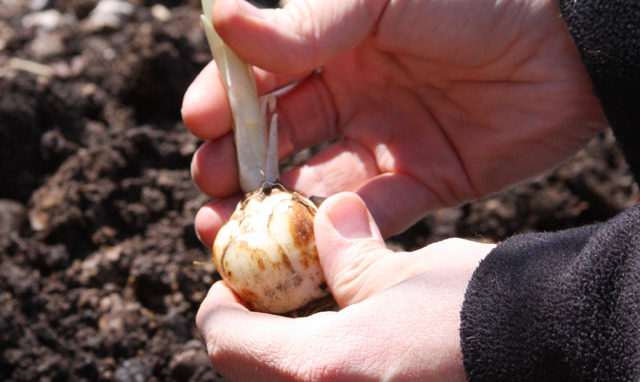
One of the most popular questions asked by beginners to bulb gardening is, “How do I know which end of the bulb to plant up?” While the answer to this question can vary based on the type of bulb, generally speaking, the pointed end of the bulb should be planted up (such as with a tulip, daffodil, or hyacinth). Also, if a bulb is smaller than the size of a nickel, there really isn’t a top and bottom.
The good news is that bulbs are quite smart and they’ll figure out which direction to grow, regardless of how they are planted! If a bulb is planted upside down, it will simply take an extra day or two to reach the surface. If after deliberating over which end is the top and you still can’t tell, plant the bulb on its side. Once again, the bulb is smart enough to know which way to grow and will now only have to travel half the distance to the surface.
A few bulbs, especially some of those bulbs planted in spring, have a more definite answer to the question. For instance, begonia tubers have a concave and convex side. In this case, the “hollow” side of tuber should be planted down and the “rounded” side up. Other tuberous spring planted bulbs such as cannas and callas grow long and narrow. These should be planted horizontally 1″ or 2″ below the ground’s surface.

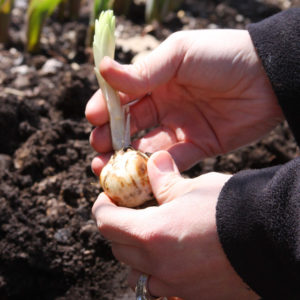
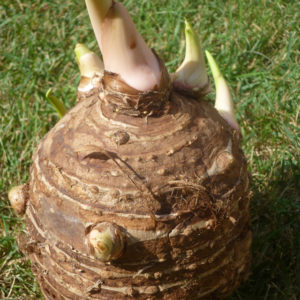
The smooth side of the Elephant Ear bulb is the top and should planted up.
Perhaps one of the most confusing bulbs to know which direction to plant is the Elephant Ear. As those of you who have previously planted one know, an Elephant Ear bulb is very round and has no definite “points”. However, most of these bulbs will have a smooth side as well as a side that contains more bumps and maybe even a few root hairs from the previous growing season. The smooth side of the Elephant Ear is typically the top and should be planted up. Chances

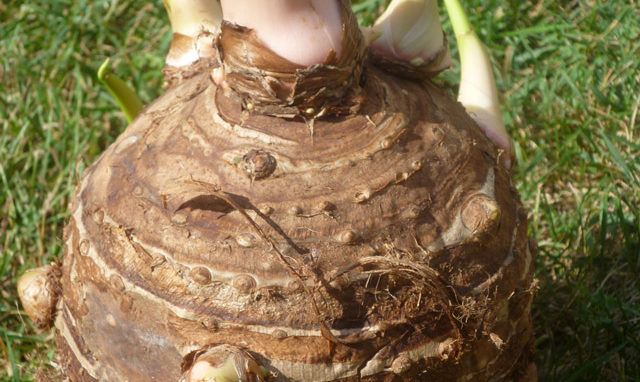
The bumpy side of the Elephant Ear bulb is the bottom and should be planted down.
are, the bumpy side with some possible hairs is slightly flatter than the smooth top side. This is the bottom. Like all bulbs, an Elephant Ear will know which way to grow regardless of how it is planted. When in doubt, plant it on its side! See pictures below for more clarification.
Spring is definitely here and gardeners everywhere are rejoicing! So get out in the garden and get to work! It’ll make you feel good
Easter blessings,

Have a question about which way to plant your bulbs or any other gardening topic? Ask Bridget! Email her at bridget@bulbblog.com! If she features your question in a future post, you’ll receive a coupon for your next order with Holland Bulb Farms!
Fri 30 Jan 2009

What says “spring” better than miniature daffodils?
Bulbs in Pots: A “One Hit Wonder” or A Lasting Treasure?
I’ve received lots of inquiries lately regarding bulbs planted in pots. We’ve all seen it: the gorgeous pots of hyacinth, tulips, and daffodils in full bloom sold at the local supermarket or floral shoppe. If you’re anything like me, you’ve probably purchased one (or at least thought about it) and triumphantly brought your little piece of spring home with you. We are all anxious for spring and who wouldn’t want a little reminder that it will one day indeed come?
So you’ve brought home the pot of adorable miniature daffodils or extremely fragrant hyacinth or maybe you’ve signed up to receive a potted Easter Lily at church and they produced gorgeous blooms for a week or two. But now what do do with these beautiful indoor bulbs after flowering? Was the money you spent on this pot of once-blooming flowers wasted? Is there nothing left to do but dispose of the pot along with the bulbs just as though it were a fresh floral arrangement? Absolutely NOT! Why not replant the bulbs in your garden or another pot to enjoy for years to come? The process is actually quite simple:
- Once the plant has stopped blooming, discontinue watering and allow the foliage to die back.
- Once the foliage is dried and brown, remove it from the pot by gently tugging on the leaves until they break from the bulb and come out of the ground. (If the leaves do not pull away from the bulbs easily you haven’t waited quite long enough for the foliage to die. It is very important to not remove the foliage prematurely as it helps to put energy back in the bulbs for the next year’s blooms.)
- Remove the bulbs from the dirt and dust them off. Check for any rotten or soft spots on bulbs. If these spots are visible on any bulbs, discard them. Allow them to dry out on a piece of paper in a cool, dry and dark place (such as a cellar or basement).

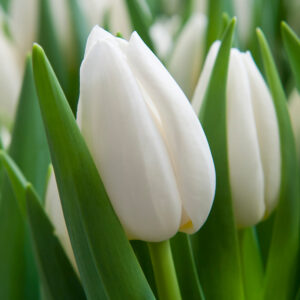
Don't throw away these gorgeous tulip bulbs...replant them!
- If you live in Hardiness Zones 3 – 8 (an area that stays consistently near or below freezing for a period of at least 10-12 weeks during the winter), the bulbs can be replanted in your outdoor garden in fall, anytime between late September and early November, preferrably prior to the first frost.
- If you live south of Hardiness Zone 8 (your winters do not fall into the above mentioned category), you will need to “pre-chill” these bulbs in October or November by placing them into your refrigerator in a brown paper bag for a period of 10-12 weeks. Be sure not to store any fruits or vegetables near your bag of bulbs as they give off a chemical called “ethylene” while ripening that can cause bulbs to rot. Once the bulbs have chilled for the correct period and may even have started to sprout, they are ready to be replanted either in the outdoors or in a pot!
So the next time you pass the floral counter at the grocery store or hear of an offer to order some potted bulbs for Easter, don’t hesitate to pick one up for yourself! Remember, spring planting bulbs work great for this, too! Good luck to you!
Until next time,
Want to learn more about planting bulbs in pots? Email Bridget at bridget@bulbblog.com! Your question may even be featured in a future blog post!